
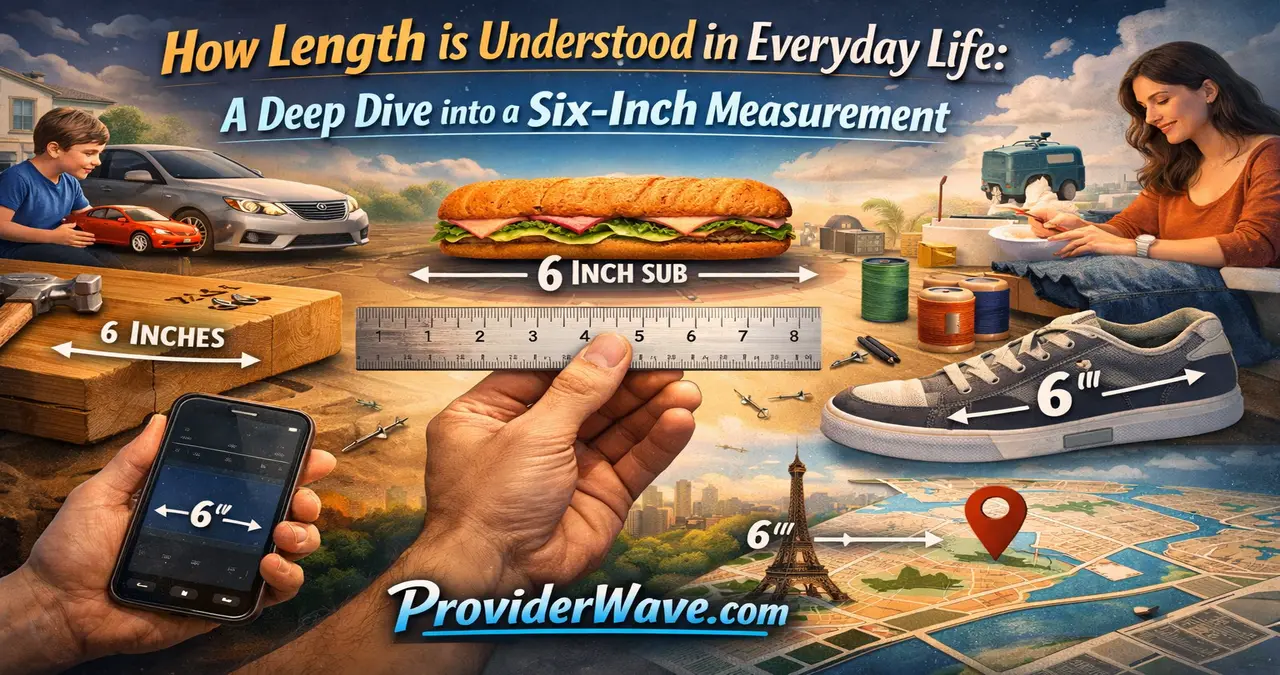
Discover how long is 6 inches with real-world comparisons, visuals, and examples to understand this common measurement easily.
When people encounter the question of “6 inches,” they are usually trying to visualize a measurement in a practical, everyday context. Whether it’s for home projects, online shopping, cooking, or general curiosity, understanding this length accurately helps bridge the gap between abstract numbers and real-world perception.
This guide breaks down the measurement in a clear, human-friendly way using comparisons, examples, and practical applications so you can instantly recognize what this length looks like in daily life.
What Does 6 Inches Really Mean in Everyday Life? How Long Is 6 Inches in Real Terms
Six inches is a mid-range measurement that sits comfortably between small handheld objects and slightly longer personal items. It is long enough to be noticeable but still short enough to be easily held in one hand.
In daily life, this length often appears in tools, gadgets, packaging, and even food items. Because it is neither too small nor too large, people frequently underestimate or overestimate it without visual reference.
Understanding the Inch as a Unit of Measurement
An inch is a standard unit in the imperial measurement system used primarily in the United States and a few other countries. It equals 1/12 of a foot and is widely used for everyday measurements like screens, objects, and height references.
Six inches simply represents six of these units combined. While the number may sound small, stacking inches together creates a length that is surprisingly versatile in practical use.
How 6 Inches Compares to the Human Hand
One of the easiest ways to understand this measurement is by comparing it to the human hand. For many adults, the distance from the base of the palm to the tip of the middle finger is close to this length, though it varies slightly by individual.
This makes it a convenient mental reference point. When you imagine stretching your hand slightly beyond its natural resting position, you begin to approximate the size more accurately.
Visualizing 6 Inches Using Common Objects
Everyday objects are often the best way to understand abstract measurements. Items like a standard smartphone width, a large banana, or a typical dollar bill and a half placed end-to-end can help visualize the length.
These comparisons make the measurement feel more intuitive, especially when no ruler is available. It’s a practical mental shortcut used in design, cooking, and DIY projects.
6 Inches in Centimeters and Metric Context
In the metric system, this length converts to approximately 15.24 centimeters. This conversion helps global audiences understand the size more clearly, especially in countries where centimeters are more commonly used.
Seeing both units side by side helps bridge international understanding and reduces confusion when working with instructions, manuals, or product specifications.
Why People Search for Size Comparisons
People often search for size comparisons because numbers alone are difficult to interpret without context. A measurement like this becomes meaningful only when it is tied to something familiar.
Whether someone is buying an item online, estimating dimensions for a project, or simply curious, visual comparison provides the clarity that raw numbers cannot.
Everyday Tools That Measure Around 6 Inches
Many common tools and objects are built around this length range. Small rulers, kitchen utensils, and portable gadgets often fall within this measurement category.
Manufacturers favor this size because it is compact, easy to handle, and efficient for storage and portability without sacrificing usability.
6 Inches in Technology and Gadgets
In the tech world, this measurement frequently appears in reference to screen sizes and compact devices. Small tablets, handheld gaming systems, and certain smartphone dimensions often align closely with this scale.
It represents a balance between portability and usability, making it a popular design choice for consumer electronics.
6 Inches in Food and Cooking References
In cooking, this length can describe portion sizes, baking trays, or food items like subs and pastries. A sandwich of this size is often considered a single serving in many deli-style meals.
Chefs and home cooks use such references to maintain consistency in presentation and portion control.
6 Inches in Fashion and Accessories
In fashion, this measurement can appear in items like belt widths, handbag dimensions, or accessory lengths. Designers often rely on standardized sizing to ensure consistency across collections.
This length is small enough to remain stylish and functional while still being noticeable in design structure.
Misconceptions About Length Estimations
A common misconception is that people can accurately estimate measurements without reference points. In reality, visual perception of length is often distorted by context, lighting, and surrounding objects.
Because of this, many individuals either underestimate or overestimate this measurement unless they compare it directly to a known standard.
Psychological Perception of Size
Human perception of size is heavily influenced by context. The same length can appear larger or smaller depending on what it is placed next to.
For example, the measurement may seem longer when isolated on a blank surface but shorter when compared to larger surrounding objects.
Practical Applications of 6-Inch Measurements
This measurement is widely used in practical scenarios such as home improvement, crafting, packaging, and digital design. It offers a convenient mid-point that is easy to work with and replicate.
Its versatility makes it a standard reference in many industries that rely on consistent sizing.
Common Object Comparison Table
Below is a practical comparison table to help visualize the length more effectively using familiar objects and references.
| Object or Reference | Approximate Length Comparison | Notes |
|---|---|---|
| Standard smartphone width | Very close | Many phones fall near this range |
| Large banana | Slightly shorter or similar | Varies by type |
| Dollar bills stacked | Around 1.5 bills | Useful for quick estimation |
| Small tablet width | Comparable | Depends on model |
| Adult hand span (partial) | Close estimate | Varies by person |
| Kitchen spatula blade | Often similar | Common household tool |
These comparisons make it easier to mentally map the size without needing a measuring device.
Historical Context of Measurement Standards
Measurement systems have evolved over centuries, with inches originating from early body-based estimations. Historically, people used thumb widths or grain sizes to define small units.
Over time, standardization created consistency, allowing measurements to be universally understood across industries and regions.
Scientific Accuracy in Estimating Length
Scientific fields require precise measurement tools rather than visual estimation. Rulers, calipers, and digital measuring devices ensure accuracy down to fractions of an inch.
This precision is essential in engineering, manufacturing, and medical applications where even small deviations matter.
How to Measure This Length Accurately at Home
If you don’t have a ruler, you can still estimate the measurement using printable guides or common objects with known dimensions. Many credit cards, for example, have standardized sizes that can serve as reference points.
Alternatively, folding paper strips or using smartphone measurement apps can provide surprisingly accurate results.
Industries Where 6 Inches Matters
Many industries rely on this measurement for design and production. From packaging design to electronics manufacturing, it often serves as a foundational reference.
Its adaptability makes it a common benchmark in both creative and technical fields.
Real-World Scenarios and Case Examples
In real-world usage, this measurement might define the size of a compact shelf, a product package, or a cooking utensil. Each scenario depends on balancing usability with space efficiency.
For example, in retail packaging, keeping items within this size range can improve shelf organization and customer handling.
Conclusion
Understanding this measurement becomes much easier when it is connected to real-world comparisons and practical examples. Instead of seeing it as a number, it transforms into something tangible and relatable.
By using everyday objects, conversion references, and contextual examples, you can confidently estimate this length in nearly any situation without needing specialized tools.
Frequently Asked Questions
How can I visualize this measurement without a ruler?
You can compare it to everyday objects like smartphones or small kitchen tools, which often fall close to this length and help provide a quick mental reference.
Is this considered a small or medium length?
It is generally considered a small-to-medium measurement, noticeable in hand but not large in spatial terms, making it highly versatile in daily use.
What is this measurement in centimeters?
It equals approximately 15.24 centimeters, which helps users in metric-based regions understand it more easily.
Why is this length commonly used in products?
Manufacturers often use it because it balances portability and usability, making it ideal for tools, gadgets, and packaging designs.
Can I estimate this length accurately without tools?
Yes, by using known objects like credit cards or phone widths, you can estimate it with reasonable accuracy for everyday tasks.