
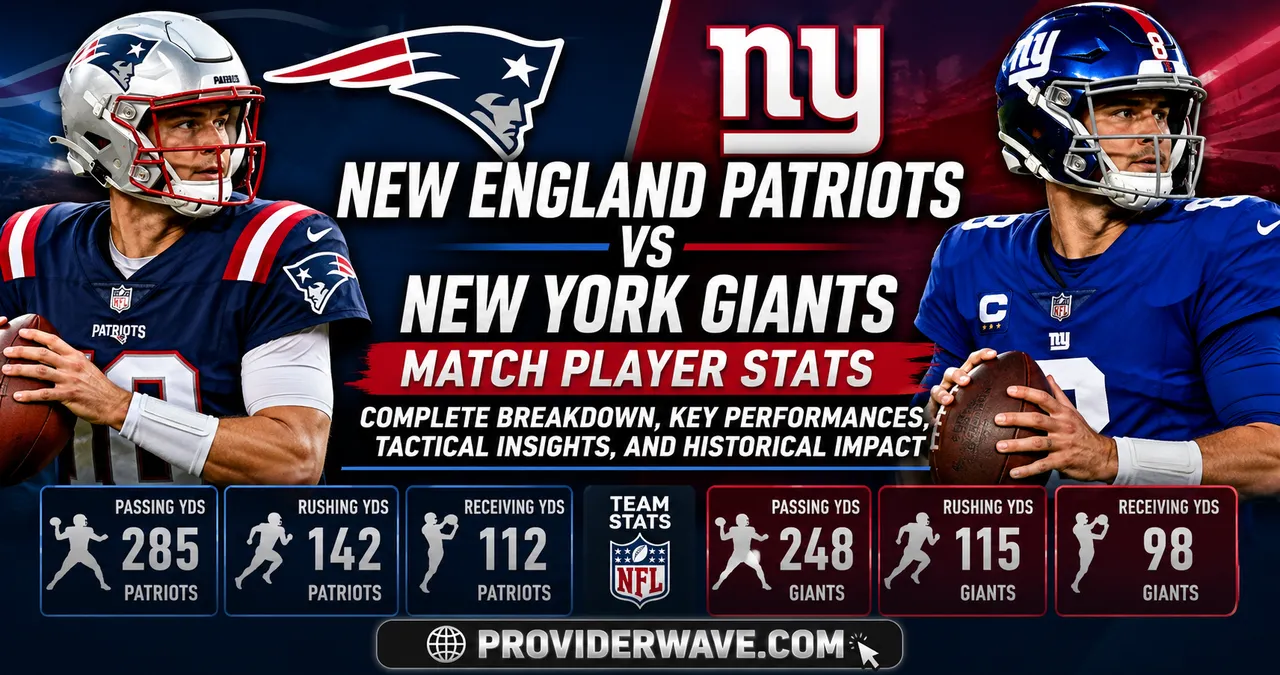
The rivalry between the New England Patriots and the New York Giants has produced some of the most memorable moments in NFL history. While the teams do not meet every season due to conference alignment, whenever they face each other, the matchup attracts enormous attention from football fans, analysts, and statisticians alike. The reason is simple: these games often feature dramatic momentum swings, elite individual performances, and unforgettable plays that influence narratives far beyond a single regular-season contest.
Examining player statistics provides a deeper understanding of how these matchups unfold. Raw numbers reveal which athletes dominated, where tactical advantages emerged, and how coaching decisions influenced outcomes. Looking beyond the final score often uncovers stories of resilience, execution, and strategic brilliance that casual viewers might overlook.
This comprehensive guide explores the most significant aspects of new england patriots vs new york giants match player stats, including quarterback production, rushing efficiency, receiving contributions, defensive impact, historical trends, tactical insights, and the broader significance of player performances throughout the rivalry.
Understanding the Importance of Match Player Statistics
Football is often described as the ultimate team sport, yet individual statistics remain one of the best ways to evaluate performance. Every passing yard, rushing attempt, tackle, sack, and interception contributes to the larger picture of how a game is won or lost.
When analyzing a Patriots-Giants matchup, statistics help identify the true difference-makers. Sometimes the spotlight shines on star quarterbacks. Other times, an underrated defensive back or a versatile running back quietly becomes the most influential player on the field.
Statistics also allow comparisons across different eras. The Patriots have experienced periods dominated by elite quarterback play and offensive precision, while the Giants have built championship-caliber teams around defensive toughness and timely offensive execution. Through statistical analysis, fans can compare performances despite changing rules, coaching philosophies, and roster structures.
As legendary coach Bill Parcells once noted, You are what your record says you are. In modern football analysis, many would add that teams are also what their statistics reveal them to be.
Historical Overview of Patriots vs Giants Matchups
The Patriots and Giants have shared a fascinating interconference rivalry spanning decades. Although they do not meet annually, their encounters have consistently generated national interest.
Most football fans immediately associate this rivalry with two iconic championship games. Those contests elevated the significance of every player statistic and transformed ordinary performances into legendary achievements.
Throughout their history, the teams have showcased contrasting identities. The Patriots often emphasized offensive efficiency, quarterback excellence, and situational execution. The Giants traditionally built around physical defense, disciplined pass rushing, and clutch performances in critical moments.
The statistical history of the rivalry reflects these philosophical differences. Patriots offenses frequently accumulated impressive yardage totals, while Giants defenses often excelled in creating pressure and forcing key mistakes.
Over time, these contrasting approaches produced a compelling statistical narrative that continues to evolve with each meeting.
Comparing Team Performance Metrics
Before examining individual players, it is helpful to compare major team performance categories that frequently determine outcomes.
| Category | Patriots Strength | Giants Strength |
|---|---|---|
| Passing Efficiency | Quick decision-making | Defensive coverage adjustments |
| Third Down Conversion | Sustained drives | Situational defense |
| Time of Possession | Ball control | Field-position management |
| Red Zone Efficiency | Precision execution | Goal-line defense |
| Defensive Pressure | Strategic blitz packages | Edge pass rushing |
| Turnover Margin | Ball security | Opportunistic takeaways |
These categories frequently appear in discussions surrounding new england patriots vs new york giants match player stats because they directly influence individual production.
When one team gains an advantage in multiple categories, standout player performances often follow naturally.
Quarterback Performances That Defined the Rivalry
Quarterbacks inevitably occupy center stage whenever football statistics are discussed. Few positions impact a game more significantly.
The Patriots enjoyed an extended era of elite quarterback play, characterized by exceptional accuracy, pre-snap recognition, and situational mastery. During many meetings with the Giants, New England quarterbacks generated substantial passing totals while maintaining high completion percentages.
On the opposite sideline, Giants quarterbacks frequently displayed resilience under pressure. Their statistical achievements often came during critical moments rather than through overwhelming volume.
One fascinating aspect of this rivalry is how quarterback numbers sometimes fail to tell the entire story. A passer might throw for more yards and touchdowns yet still lose because of defensive pressure, field position battles, or turnover differentials.
In several memorable contests, Giants quarterbacks delivered efficient rather than explosive statistical performances. Meanwhile, Patriots quarterbacks often produced gaudier numbers but faced defensive schemes specifically designed to disrupt timing and rhythm.
The result was a rivalry where context mattered as much as the numbers themselves.
Passing Statistics and Offensive Production
Passing attacks have played a major role in shaping outcomes between these franchises.
When evaluating passing statistics, analysts typically focus on several core metrics:
Completion percentage demonstrates accuracy and decision-making.
Passing yards reveal offensive productivity.
Touchdown passes highlight scoring efficiency.
Interceptions measure risk management.
Quarterback rating combines multiple performance indicators into a single figure.
In many notable matchups, Patriots passers excelled in completion percentage and total yardage. Their offensive systems frequently emphasized quick releases, route precision, and exploiting defensive mismatches.
The Giants often countered with aggressive pass-rushing strategies designed to reduce efficiency. While this approach occasionally allowed yardage accumulation, it frequently produced game-changing sacks and turnovers.
Statistically, some of the most intriguing examples of new england patriots vs new york giants match player stats involve situations where passing yardage favored New England while pressure metrics favored New York.
Those contrasting statistical strengths created highly competitive contests.
The Role of Running Backs in Key Games
Although quarterback play receives most headlines, running backs have repeatedly influenced the outcome of Patriots-Giants matchups.
Strong rushing performances provide balance, control tempo, and reduce defensive pressure on quarterbacks. Teams capable of establishing the run often dictate game flow and maintain possession advantages.
The Patriots traditionally utilized versatile running backs capable of contributing as both rushers and receivers. This versatility often generated favorable matchups against linebackers and defensive backs.
The Giants, meanwhile, frequently relied on powerful runners capable of gaining difficult yards between the tackles. These players excelled at sustaining drives and controlling clock management.
A productive rushing attack often translates into stronger play-action opportunities, improved red-zone efficiency, and greater offensive flexibility.
When reviewing historical statistics, several contests reveal that rushing efficiency—not total rushing yards—proved most significant. Averaging five yards per carry frequently had a greater impact than accumulating large totals through sheer volume.
This subtle statistical detail often explains why some games unfolded differently than expected.
Receiving Leaders and Game-Changing Playmakers
Wide receivers and tight ends have delivered some of the rivalry’s most memorable moments.
Elite receiving performances typically emerge through a combination of route running, athleticism, quarterback chemistry, and offensive design. Statistics such as receptions, receiving yards, yards after catch, and touchdown receptions provide valuable insight into player effectiveness.
Patriots receiving groups often emphasized precision and adaptability. Their offensive systems enabled multiple players to contribute significantly within a single game.
The Giants frequently relied on explosive playmakers capable of stretching defenses vertically. These athletes could alter momentum with a single reception.
One common trend visible in new england patriots vs new york giants match player stats is the importance of third-down receptions. While overall yardage receives greater attention, clutch catches during critical situations often determine outcomes.
A receiver recording eight catches for 85 yards may ultimately contribute more than a player posting 120 yards through a few isolated explosive plays.
Situational impact remains a crucial factor when evaluating receiving statistics.
Defensive Statistics That Changed Outcomes
Defense has always played a major role in this rivalry.
Many of the most significant moments originated from defensive excellence rather than offensive fireworks. Statistics such as sacks, tackles for loss, quarterback hits, interceptions, forced fumbles, and passes defended frequently tell the true story of these contests.
The Giants historically built their identity around pass-rushing dominance. Defensive linemen and edge rushers consistently disrupted opposing quarterbacks and created pressure situations.
The Patriots emphasized disciplined defensive execution. Their schemes often focused on eliminating an opponent’s primary strength while forcing secondary options to beat them.
Defensive statistics reveal that pressure often matters even when it does not result in a sack. Quarterback hits, hurried throws, and altered timing can dramatically impact offensive efficiency.
Some of the most celebrated defensive performances in NFL history occurred during Patriots-Giants games, demonstrating the enormous value of defensive statistics in understanding outcomes.
Linebacker Contributions Beyond Traditional Numbers
Linebackers occupy one of football’s most demanding positions.
These players must defend against the run, cover receivers, rush the passer, and communicate defensive adjustments. Consequently, their impact extends beyond traditional box-score statistics.
Tackle totals provide a useful starting point, but advanced evaluation requires deeper analysis. Run-stop percentage, coverage effectiveness, blitz productivity, and situational performance all contribute to a linebacker’s value.
The Giants have frequently featured linebackers known for physicality and tackling consistency. The Patriots, meanwhile, often deployed versatile linebackers capable of executing multiple responsibilities within complex defensive schemes.
When studying new england patriots vs new york giants match player stats, linebacker performances often explain how offenses were contained or disrupted.
A linebacker recording ten tackles while limiting explosive plays may contribute as much to victory as a quarterback throwing multiple touchdowns.
Secondary Performance and Coverage Metrics
Modern football increasingly emphasizes pass defense, making secondary play more important than ever.
Cornerbacks and safeties influence outcomes through coverage skills, ball production, and communication. Their effectiveness often appears indirectly within statistical records.
Metrics such as interceptions, passes defended, completion percentage allowed, and coverage success rates provide valuable insights into performance.
Patriots defensive backs traditionally excelled in situational awareness and adaptability. Giants defensive backs frequently combined physicality with aggressive ball pursuit.
One interesting trend involves the relationship between pass-rush success and secondary performance. Strong pressure often creates interception opportunities by forcing hurried throws.
Therefore, coverage statistics and pass-rush metrics should be analyzed together rather than independently.
This interconnected relationship frequently appears throughout the rivalry’s statistical history.
Special Teams Impact on Match Results
Special teams frequently determine field position, momentum, and scoring opportunities.
Despite receiving less attention than offense and defense, special-teams statistics often influence close games significantly.
Key metrics include:
Field-goal percentage
Punt average
Kick-return average
Punt-return average
Touchback percentage
Blocked kicks
Both franchises have benefited from reliable specialists throughout their histories. Accurate kicking and disciplined coverage units often provided hidden advantages that influenced outcomes.
Field position represents one of football’s most underrated statistical factors. Starting drives closer to midfield dramatically increases scoring probability.
Therefore, special-teams performance deserves recognition when analyzing comprehensive player statistics.
Red Zone Performance and Scoring Efficiency
Red-zone execution separates good teams from great teams.
Accumulating yards is valuable, but converting opportunities into touchdowns ultimately determines results. Consequently, red-zone statistics provide critical context.
Quarterbacks, running backs, offensive linemen, and play-callers all contribute to red-zone success. Defensively, discipline and situational awareness become even more important near the goal line.
The Patriots historically excelled in red-zone efficiency through precise execution and strategic flexibility. The Giants frequently countered with physical defense and pressure-oriented tactics.
Examining scoring efficiency often reveals why certain games produced surprising outcomes despite relatively balanced yardage totals.
Teams capable of maximizing red-zone opportunities consistently gain statistical and competitive advantages.
Turnovers and Their Statistical Significance
Few statistical categories influence football outcomes more dramatically than turnovers.
Interceptions and fumbles can instantly alter momentum, field position, and scoring potential. As a result, turnover statistics receive substantial attention from coaches and analysts.
Historical Patriots-Giants contests frequently demonstrate the impact of turnover differential. Teams protecting the football generally improved their chances of victory considerably.
A single interception returned deep into opponent territory can produce greater impact than hundreds of offensive yards accumulated elsewhere.
Analysts often emphasize that turnover margin strongly correlates with winning percentage. This relationship appears consistently throughout NFL history and remains evident within this rivalry.
When evaluating new england patriots vs new york giants match player stats, turnover-related metrics deserve particular attention.
Offensive Line Performance and Hidden Statistics
Offensive linemen rarely receive headlines, yet their contributions shape virtually every offensive statistic.
Quarterback success, rushing efficiency, and overall offensive productivity depend heavily on blocking effectiveness.
Traditional statistics provide limited insight into offensive-line performance. However, sacks allowed, rushing averages, pressure rates, and short-yardage success offer valuable indicators.
The Patriots often fielded technically disciplined offensive lines focused on communication and consistency. The Giants frequently relied on physical line play designed to establish offensive balance.
Strong line performance enables playmakers to maximize their abilities while minimizing defensive disruption.
Consequently, many impressive skill-position statistics originate from outstanding work in the trenches.
Coaching Influence on Statistical Outcomes
Statistics do not emerge in isolation. Coaching decisions significantly influence player production.
Game plans determine offensive emphasis, defensive priorities, personnel usage, and situational strategy. These choices directly affect individual statistics.
Patriots coaching staffs traditionally emphasized adaptability and opponent-specific preparation. Giants coaches often prioritized physicality, discipline, and defensive execution.
Strategic adjustments can dramatically alter statistical outcomes. A coach identifying a favorable matchup may generate increased production for a specific receiver or running back.
Likewise, defensive adjustments can limit star players and force offenses toward alternative options.
Understanding coaching influence provides valuable context for interpreting player statistics accurately.
Memorable Individual Performances
Every rivalry develops iconic individual performances that remain memorable for years.
Some players dominate through overwhelming production. Others deliver timely contributions that exceed their statistical volume.
Notable performances often include combinations of:
High passing yardage
Multiple touchdown passes
Explosive rushing totals
Game-changing interceptions
Dominant sack numbers
Critical special-teams plays
The most memorable statistical achievements frequently occur under intense pressure. High-stakes environments amplify the significance of every yard, tackle, and turnover.
This reality helps explain why certain Patriots-Giants performances continue to resonate long after final whistles have blown.
Advanced Analytics and Modern Evaluation
Traditional statistics remain valuable, but advanced analytics provide deeper insights.
Modern analysts utilize metrics such as expected points added (EPA), success rate, completion percentage over expectation (CPOE), and win probability added.
These measurements help quantify player impact beyond conventional box scores.
For example, a short third-down completion may contribute more to winning probability than a longer gain occurring in a less critical situation.
Advanced analytics often reveal hidden contributors whose impact might otherwise go unnoticed.
Combining traditional and advanced metrics creates a more comprehensive understanding of player performance and team success.
How Statistical Trends Have Evolved
Football continues evolving, and statistical trends reflect these changes.
Passing volume has increased significantly over recent decades. Offensive schemes now emphasize spacing, efficiency, and matchup exploitation.
Defenses have adapted through greater versatility, disguised coverages, and hybrid personnel groupings.
As a result, comparing statistics across eras requires context. A passing total considered exceptional decades ago might appear routine today.
Nevertheless, core principles remain unchanged. Efficiency, execution, discipline, and situational performance continue determining outcomes regardless of era.
The evolution of football strategy adds another fascinating dimension to analyzing historical statistics.
What Fans Can Learn From Player Statistics
Statistics enhance appreciation for football’s complexity.
Rather than focusing solely on final scores, fans can use statistical analysis to understand why games unfold as they do. Numbers reveal strengths, weaknesses, adjustments, and turning points.
A deeper understanding of player statistics also highlights contributions that casual observation may overlook.
Offensive linemen, linebackers, safeties, and special-teams specialists frequently influence outcomes despite receiving limited media attention.
Learning to interpret statistics allows fans to evaluate performances more accurately and enjoy the game on a deeper level.
This analytical perspective transforms football from simple entertainment into a richly layered strategic contest.
Why Patriots vs Giants Statistics Continue to Fascinate Fans
The Patriots and Giants occupy unique places within NFL history.
Their meetings have combined elite talent, dramatic moments, tactical intrigue, and championship implications. Consequently, statistical analysis remains especially compelling.
Fans continue revisiting historical data to compare performances, evaluate legacies, and understand pivotal moments. Every matchup adds new chapters to an already fascinating story.
The enduring appeal stems from the rivalry’s unpredictability. Statistical favorites have not always prevailed, creating compelling debates about the relationship between numbers and outcomes.
This balance between measurable performance and competitive drama helps explain the lasting fascination surrounding these contests.
Conclusion
The story of new england patriots vs new york giants match player stats extends far beyond basic box scores. Every passing yard, rushing attempt, reception, tackle, sack, interception, and special-teams contribution helps explain how games are won and lost.
Throughout their history, the Patriots and Giants have produced memorable contests defined by contrasting strengths, elite performers, and strategic battles. Quarterbacks have delivered headline-grabbing numbers, but defensive stars, offensive linemen, special-teams contributors, and coaches have often played equally important roles.
Analyzing statistics reveals the deeper narrative behind each matchup. It highlights efficiency over volume, situational excellence over raw production, and execution over expectations. Whether examining historical championship games or regular-season encounters, player statistics provide invaluable insight into one of football’s most intriguing interconference rivalries.
For fans, analysts, and football enthusiasts, understanding these numbers enriches appreciation of the sport and offers a clearer perspective on what truly determines success on the field.
FAQs
What are the most important statistics in Patriots vs Giants games?
The most important statistics typically include passing efficiency, turnover margin, third-down conversion rate, red-zone success, sacks, and time of possession. These categories often provide a clearer picture of performance than total yardage alone. When reviewing new england patriots vs new york giants match player stats, these metrics consistently emerge as major indicators of success.
Why do defensive statistics matter so much in this rivalry?
Defensive statistics matter because many Patriots-Giants games have been influenced by pressure, coverage, and turnover creation. Sacks, interceptions, quarterback hits, and tackles for loss frequently changed momentum and directly impacted scoring opportunities. Strong defensive performances have often neutralized explosive offenses.
How should fans compare player statistics from different eras?
Fans should account for changes in league rules, offensive philosophy, and overall game pace. Passing numbers have generally increased over time, making direct comparisons difficult. Evaluating efficiency, relative dominance, and impact within a player’s era provides a more accurate assessment than comparing raw totals alone.
Which offensive statistics best predict success?
Completion percentage, yards per attempt, rushing efficiency, red-zone conversion rate, and third-down success are among the strongest predictors of offensive effectiveness. These metrics measure consistency and execution rather than simple volume. They frequently appear in discussions about new england patriots vs new york giants match player stats because of their strong connection to winning outcomes.
Are advanced analytics better than traditional statistics?
Advanced analytics and traditional statistics work best together. Traditional metrics provide accessible information about production, while advanced analytics offer deeper insight into efficiency and situational impact. Combining both approaches creates the most complete evaluation of player performance.
Why are special-teams statistics often overlooked?
Special teams receive less attention because their contributions occur less frequently than offensive or defensive plays. However, field position, kicking accuracy, return efficiency, and coverage performance can dramatically influence outcomes. In close games, special-teams statistics often prove decisive.
What makes Patriots vs Giants matchups historically significant?
These matchups are significant because they have featured elite players, memorable performances, championship implications, and dramatic moments. The rivalry showcases contrasting football philosophies and has produced some of the NFL’s most analyzed games. As a result, new england patriots vs new york giants match player stats remain a popular topic among football fans and analysts alike.