
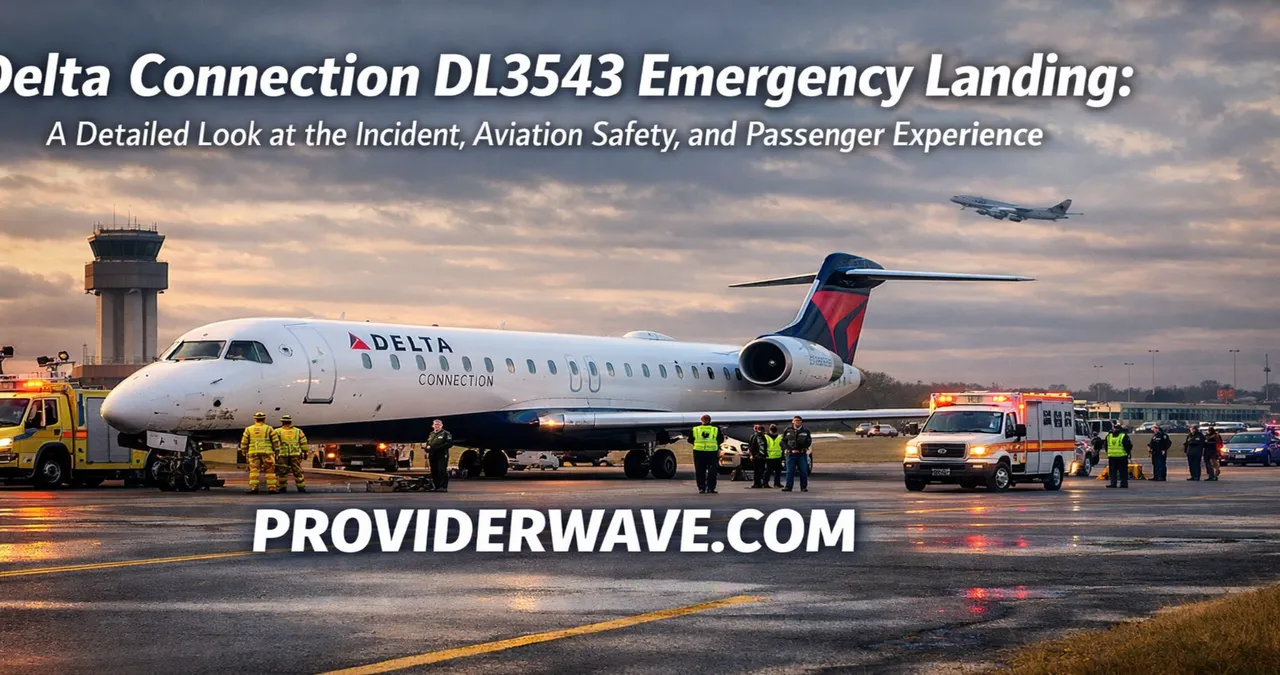
Delta Connection DL3543 emergency landing explained in detail, covering causes, passenger experience, aviation safety protocols, and expert insights into how emergency landings are handled professionally.
The delta connection dl3543 emergency landing quickly became a topic of widespread discussion among travelers, aviation observers, and media outlets. Whenever a commercial flight makes an unplanned landing, it naturally raises concern and curiosity. People want to know what happened, whether passengers were safe, and how airlines handle such situations behind the scenes. In the case of delta connection dl3543 emergency landing, the story highlights not just a single operational event but the depth of modern aviation safety systems and airline preparedness.
In this article, we will explore the details surrounding delta connection dl3543 emergency landing, analyze how emergency landings are managed in commercial aviation, and understand what this event reveals about airline safety protocols. The goal is to present accurate, clear, and expert-level insights in a way that remains easy to understand for every reader.
Understanding Delta Connection and Regional Flight Operations
Delta Air Lines operates one of the largest airline networks in the world. Under its regional brand, Delta Connection, flights are often operated by partner carriers using smaller aircraft to connect regional airports with major hubs. These flights play a crucial role in maintaining network connectivity.
Regional operations, like the one involved in delta connection dl3543 emergency landing, typically use aircraft designed for short to medium distances. These aircraft are maintained under the same federal safety standards as mainline jets. The crew members are professionally trained and certified under strict aviation regulations. While regional aircraft may be smaller in size, their safety protocols are no different from larger commercial jets.
When discussing delta connection dl3543 emergency landing, it is important to understand that emergency landings are not rare anomalies in aviation. Instead, they are structured safety procedures designed to prevent larger problems.
What Is an Emergency Landing in Commercial Aviation
An emergency landing occurs when a flight crew determines that continuing to the original destination could compromise safety. This does not automatically mean that the aircraft was in severe danger. In many cases, emergency landings are precautionary.
There are different categories of emergency landings:
| Type of Landing | Description |
|---|---|
| Precautionary Landing | Conducted due to minor technical issues or medical concerns |
| Priority Landing | Aircraft receives expedited clearance but situation is controlled |
| Immediate Emergency Landing | Urgent situation requiring rapid descent and landing |
In the case of delta connection dl3543 emergency landing, available reports indicate that safety protocols were activated appropriately. The flight crew made a decision prioritizing passenger well-being over schedule convenience. This is exactly how aviation systems are designed to function.
Possible Causes Behind Delta Connection DL3543 Emergency Landing
While specific details depend on official airline statements and aviation authority reports, emergency landings generally occur due to several common reasons:
Mechanical Alerts
Modern aircraft are equipped with sophisticated monitoring systems. If a system detects irregular pressure, engine performance anomalies, hydraulic fluctuations, or electrical irregularities, pilots receive alerts instantly. Many of these warnings are precautionary rather than catastrophic.
In situations like delta connection dl3543 emergency landing, pilots follow a structured checklist procedure. They communicate with air traffic control and decide whether returning to departure airport or diverting to the nearest suitable airport is the safest course of action.
Medical Emergencies
Another common reason for emergency landings involves passenger health. If a traveler experiences a severe medical condition mid-flight, the crew may declare an emergency to receive priority landing clearance.
Environmental Factors
Unexpected weather patterns, bird strikes, or runway obstructions may also trigger diversion decisions. Pilots are trained to evaluate multiple risk factors in real time.
Regardless of the specific cause, the primary principle guiding delta connection dl3543 emergency landing would have been risk minimization.
How Pilots Handle In-Flight Emergencies
Commercial pilots undergo extensive simulator training. They practice hundreds of emergency scenarios before ever encountering one in real operations. During delta connection dl3543 emergency landing, the cockpit crew likely followed a structured sequence:
- Identification of the issue
- Execution of emergency checklist
- Communication with air traffic control
- Coordination with cabin crew
- Passenger briefing
- Safe approach and landing
This sequence happens calmly and methodically. Contrary to dramatic portrayals in movies, aviation emergencies are rarely chaotic inside the cockpit.
Aviation operates on layered safety systems. If one system shows irregular behavior, backup systems and redundancy measures activate. That is why emergency landings often result in safe outcomes.
Passenger Experience During Delta Connection DL3543 Emergency Landing
For passengers, hearing the words “emergency landing” can be unsettling. However, cabin crews are trained to manage communication carefully. They provide reassurance while maintaining professionalism.
Most passengers on flights like delta connection dl3543 emergency landing report that the landing itself feels normal. In many cases, travelers may not even realize the seriousness of the decision until after the aircraft reaches the gate.
Flight attendants also follow structured safety procedures:
- Securing cabin equipment
- Confirming seatbelt compliance
- Preparing emergency exits if necessary
- Coordinating with ground response teams
The cabin environment is designed to remain orderly and controlled.
Role of Air Traffic Control in Emergency Diversions
Air traffic control plays a critical role during situations like delta connection dl3543 emergency landing. Once a pilot declares an emergency, controllers immediately prioritize that aircraft. Other flights may be delayed to provide clear airspace and runway access.
Controllers coordinate with airport emergency response teams. Fire trucks, medical units, and inspection crews may be positioned near the runway as a precaution. This does not necessarily mean there is fire or visible danger. It is simply part of aviation’s safety-first culture.
The smooth coordination between cockpit crew and air traffic control demonstrates the strength of aviation infrastructure.
Aircraft Inspection After Emergency Landing
After delta connection dl3543 emergency landing, the aircraft would not immediately resume service. Instead, maintenance engineers conduct thorough inspections. They review cockpit logs, analyze system warnings, and inspect mechanical components.
Airlines follow strict maintenance protocols governed by federal aviation authorities. No aircraft returns to service unless engineers confirm full compliance with safety standards.
This process protects future passengers and ensures transparency in airline operations.
Media Coverage and Public Reaction
Whenever an event like delta connection dl3543 emergency landing occurs, media outlets often amplify the story. Headlines may use dramatic language, even when the situation was handled smoothly.
It is important for readers to differentiate between precautionary safety measures and genuine crises. Aviation safety data consistently shows that commercial air travel remains one of the safest forms of transportation.
Public interest in events like delta connection dl3543 emergency landing often reflects broader anxiety about flying. However, such incidents frequently demonstrate how effective aviation safety systems truly are.
Aviation Safety Statistics and Context
Commercial aviation operates under intense regulatory oversight. Aircraft maintenance schedules, pilot training programs, and safety audits are continuously updated.
Events like delta connection dl3543 emergency landing actually showcase system resilience. The aircraft landed safely because protocols worked as designed. Modern jets contain redundant systems, meaning critical components have backups.
The aviation industry prioritizes risk management long before passengers board the aircraft.
Lessons Learned from Delta Connection DL3543 Emergency Landing
Every operational event becomes a learning opportunity. Airlines conduct internal reviews to determine whether improvements can be made in communication, maintenance scheduling, or procedural clarity.
The delta connection dl3543 emergency landing reinforces several key lessons:
- Precautionary decisions protect lives
- Crew training remains essential
- Communication transparency builds public trust
- Redundancy systems enhance safety
Such events often strengthen safety culture rather than weaken it.
Frequently Asked Questions
What caused delta connection dl3543 emergency landing
While official details depend on airline statements, emergency landings typically result from mechanical alerts, medical situations, or precautionary decisions made by pilots.
Were passengers injured during delta connection dl3543 emergency landing
Reports indicate that passengers were safe and the landing was conducted under controlled conditions.
Are emergency landings common in commercial aviation
They are uncommon but not rare. Many are precautionary and do not indicate catastrophic danger.
Does an emergency landing mean the aircraft was failing
Not necessarily. Often, it means the crew identified a minor irregularity and chose to land as a preventive measure.
How safe is flying after incidents like delta connection dl3543 emergency landing
Commercial aviation remains extremely safe due to strict regulations, pilot training, and maintenance protocols.
Conclusion
The delta connection dl3543 emergency landing serves as a reminder of how structured and safety-focused modern aviation truly is. While the phrase “emergency landing” may sound alarming, the reality often reflects careful decision-making, advanced technology, and disciplined crew coordination. The safe outcome underscores the reliability of airline safety systems and the professionalism of flight crews.